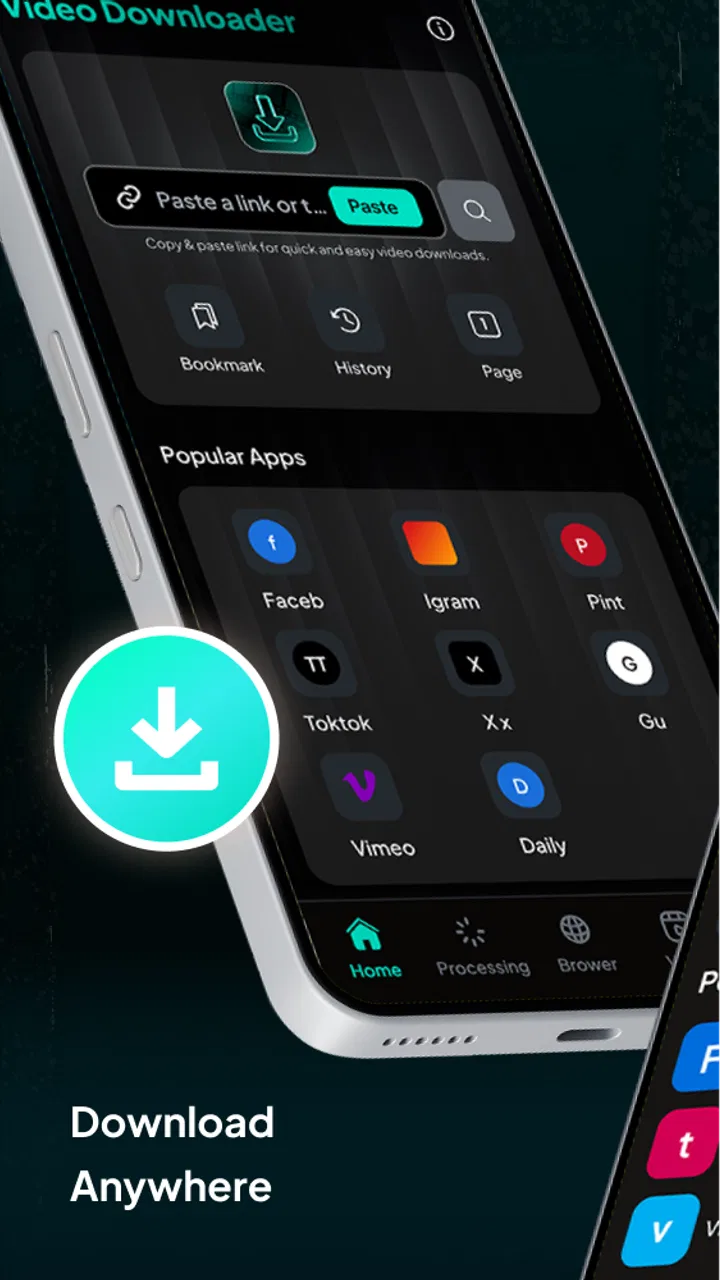
VidoSave: Video Downloader
- 0.0
- Rating
- 500.00K
- Installs
- Free
- Price

 Analysis by App-foxy
I found VidoSave: Video Downloader positioned as a straightforward video utility from Kaizo Innovation, aimed at people who want to save online video rather than edit it. Its place in the Video Players & Editors category makes sense, although the experience is much more focused on downloading and keeping clips available than on cutting, adding effects, or publishing finished projects. I approached it as an everyday tool: find a video, pass its address to the app, choose a suitable quality, and check that the saved file is actually usable afterward.
That simple workflow is the main reason to consider it. VidoSave is free to start, has an Everyone content rating, and is listed at version 1.0.0 with support beginning at Android 8.1. The developer is Kaizo Innovation, and the app has passed the half-million-install mark. Those details suggest a fairly accessible utility rather than a specialist production suite. At the same time, the average rating currently shown is 0.0, so I would not treat the app as a proven replacement for every established downloader. I see it as something worth testing carefully for a particular routine.
How I would use VidoSave in a normal day
The most practical starting point is to keep the task narrow. When I need a clip for offline viewing, I first copy its address from the service where I found it, then open VidoSave and use the available download flow. I prefer doing this one video at a time at first, because it makes it easier to notice whether the source is accepted, whether the selected quality is sensible, and where the resulting file appears on the phone.
You May Also Like

 Blood Strike: 2.5 Anniversary
Blood Strike’s Loadouts Turn Every Drop Into a Tactical Gamble
A close look at Blood Strike’s custom loadouts: how fast access to signature weapons reshapes its battle royale rhythm, rewards preparation, and narrows the gap between fights.

 Pandora - Music & Podcasts
Pandora’s Music Is Easy to Start, but Harder to Recover
Pandora’s strength is its low-effort path from a seed to a station. Its weak spot is how much confidence it asks you to place in connection, setup, and quiet recovery.

 8 Ball Pool
 Is Built on Rivalries, Rematches, and Routine
A close look at the rivalries, rematches, shared routines, and unanswered safety questions that turn a quick pool match into a persistent mobile community.

 Samsung Music
’s Quiet Strength Is Playing What You Already Own
Its reach comes less from spectacle than from dependable access to a personal library. That simplicity is both the app’s strongest retention engine and its ceiling.

 AccuWeather: Weather Radar
AccuWeather Review: A Quick, Clear Forecast for Everyday Decisions
For everyday plans, the best forecast is the one you can understand quickly. AccuWeather makes rain timing, radar, and local conditions easy to act on, with a few trade-offs.

 Hill Climb Racing
Why Hill Climb Racing Still Turns Crashes Into One More Run
A tiny car, a bumpy hill and one more upgrade: Hill Climb Racing keeps resurfacing because its simple chaos makes every near-miss feel personal.
More From Our News Desk
View All News


This matters because “downloading a video” is not one single outcome. A short clip for a commute needs very different storage planning from a long high-definition recording. The app’s store positioning mentions fast downloads, four-kay video, and high-definition saving, but I would not automatically choose the highest option. A smaller file can be the better choice when the phone has limited space or when the goal is simply to watch on a compact screen.
My preferred everyday scenario is preparing a few videos before a train journey. I would connect to a reliable network, copy each video address, select a quality that matches the phone and available storage, and then open the saved files before leaving home. That last check is easy to skip, but it is the difference between having a useful offline library and discovering later that a file is incomplete, silent, or saved somewhere inconvenient.
I also recommend creating a simple naming habit. If VidoSave leaves files with generic names, I would rename them immediately after downloading, using a short subject and date rather than allowing a folder to fill with indistinguishable titles. This is not a glamorous feature, but it makes the app much more useful over time. A downloader becomes frustrating when finding an old clip takes longer than downloading it.
Choosing quality without wasting storage
The promise of high-definition and four-kay saving is attractive for large screens, archival copies, or footage that will later be edited. It is less compelling for casual viewing on a phone. I would reserve the highest quality for videos where detail genuinely matters, such as demonstrations, landscape footage, or material I intend to move to a larger display. For spoken content, tutorials, and reference clips, a moderate setting is often the more sensible compromise.
There is another trade-off that experienced users notice quickly: a larger file takes longer to transfer, occupies more space, and may be harder to manage when several downloads are queued. A fast downloader is not automatically efficient if every task is performed at maximum quality. My rule would be to decide the purpose first, then choose quality, rather than treating the best-looking option as the default.
Before saving anything important, I would also check whether the source itself provides an official offline option. VidoSave can be convenient when a normal download is appropriate, but an official feature may preserve subtitles, playlists, creator controls, or other context more reliably. The app should complement legitimate viewing options, not encourage saving material that the owner has restricted.
Settings and habits that make the workflow less frustrating
Because VidoSave is presented as a focused utility, I would spend a few minutes inspecting its settings before relying on it. The useful questions are practical: can I choose a destination folder, can I select a file format or quality, does the app show download progress, and can I tell when a task has finished? I would only enable options that I understand, especially if a setting affects storage location or how the app handles repeated files.
Storage deserves particular attention. High-resolution video can consume space quickly, and a downloader is easy to forget after the file has been saved. I would leave room for the operating system and other apps instead of treating every free gigabyte as available for video. After watching a file, I would delete temporary or duplicate copies rather than allowing the download folder to become a hidden storage drain.
Notifications are another small but important part of the routine. If the app offers completion alerts, they can help when I switch to another task. If notifications become noisy, I would reduce them at the system level rather than repeatedly opening the app to check progress. The best setting is the one that tells me a download needs attention without turning every saved clip into an interruption.
I would also test the destination with a nonessential video before starting a large batch. This answers an important practical question: will the file be easy to locate and open in the player I normally use? A download that exists but is hidden in an unfamiliar folder is technically successful yet practically inconvenient. Confirming the path early prevents a lot of unnecessary searching later.
Why a repeatable routine beats random tapping
My recommended routine is deliberately boring: copy the address, open the downloader, choose the intended quality, start the task, verify the result, and rename or remove the file. Repeating the same sequence reduces mistakes. It also makes it easier to identify whether a problem comes from the source, the chosen quality, the network, or the app itself.
For people who download often, I would keep a short note of which quality works best for different purposes. One setting might suit short social clips, another might be appropriate for educational material, and a higher option might be reserved for footage that will be edited. This is more useful than blindly selecting the same setting every time because it connects the technical choice to the actual reason for saving the video.
There is a privacy-minded benefit to this approach too. I would avoid pasting addresses from unknown sources and would not use a downloader as a reason to open suspicious files. Keeping the workflow limited to familiar sources and reviewing what has been saved makes the app easier to trust in daily use. The Everyone rating describes the intended age suitability, but it does not remove the need for ordinary caution around online content.
Where VidoSave is convenient, and where alternatives may win
Compared with a browser alone, a dedicated downloader can make the saving process feel more direct. Instead of navigating through several menus every time, I can use a focused tool for the specific job. That is especially helpful when I regularly prepare videos for offline viewing and want a separate place to manage them.
Compared with a full video editor, however, VidoSave is much narrower. It is not the app I would choose for trimming a recording, adding captions, correcting color, mixing audio, or building a social post. A normal gallery and media player may be enough for someone who only wants to watch local files, while an editor is better for someone whose real goal is to create something new.
Browser-based download services can appear faster because they require no dedicated installation, but I find them less comfortable for a repeatable mobile workflow. They may involve extra pages, confusing buttons, or more opportunities to tap the wrong thing. On the other hand, a browser can be preferable when I only need one occasional, legitimate download and do not want another app on the phone.
Official platform tools remain the better choice when they offer dependable offline playback. They usually understand the service’s own restrictions and may handle account access, subtitles, or playback rights more cleanly. VidoSave is most appealing when I need a general-purpose saving workflow for content that can lawfully be downloaded and managed as a local file.
Questions I would settle before depending on it
One question is whether it works with every video source. I would not assume that. Compatibility can depend on the service, the address format, access restrictions, and the way a video is delivered. My advice is to test the exact sources I care about before planning a trip or building a large archive around the app.
Another question is whether the saved file will include everything I expect. A video may have separate audio, captions, chapters, or other elements that do not always behave like one simple file. I would open a sample in the player I intend to use and check picture, sound, duration, and subtitles before deleting the original reference.
Users also need to think about purchases. The app is free, but in-app items are listed from $2.99 to $29.99 each. I would check what an optional purchase changes before paying, particularly if the free workflow already covers occasional use. Someone downloading only once in a while may find that the free version is sufficient, while a frequent user may value an upgrade only if it removes a specific obstacle.
Finally, I would ask whether the app fits my phone’s age and storage situation. Android 8.1 is the minimum operating system listed, which keeps the basic compatibility range fairly broad, but older hardware may still struggle with very large files or high-resolution playback. A newer phone with limited free space has a different problem from an older phone with ample storage, so the right quality choice depends on both.
Advanced limits and responsible use
The biggest limitation is that a downloader cannot overcome restrictions imposed by a source. If a video is private, protected, unavailable in a region, or not offered for saving, repeated attempts may not produce a useful result. I would treat a failed download as a signal to check the source and its permissions rather than assuming that changing quality will solve everything.
There is also a difference between having a local copy and having permission to redistribute it. I would use VidoSave for personal offline access, reference, or other clearly permitted purposes, and I would not repost someone else’s work simply because it can be saved. This is particularly important when the app makes downloading feel effortless.
For archiving, I would keep the original address and a brief note alongside important files. Local copies can become separated from their context, and a filename alone may not tell me who made the video or why I saved it. A small, organized archive is more valuable than a large folder of anonymous clips. I would also back up irreplaceable material through my normal storage method rather than relying on one phone.
Batch behavior deserves caution as well. Even if the app makes multiple downloads possible, I would begin with a small group and watch how the phone handles storage, notifications, and file naming. If several files receive confusing names or one failed task is hard to identify, a slower, deliberate queue is better than maximizing the number of simultaneous jobs.
The current version is 1.0.0, so I would approach it as an early version and keep my expectations measured. That does not make it unusable, but it does make testing important. I would confirm the functions I need on my own device, keep another legitimate viewing method available, and avoid making it the only place where valuable material exists.
My verdict after building a practical workflow
I like the basic idea behind VidoSave: Video Downloader because it concentrates on a task many people want to perform quickly: saving video for later viewing. Its free entry point, broad age suitability, and support for older Android devices make it approachable. The appeal is strongest for someone who regularly handles permitted video links and wants a dedicated alternative to juggling browser pages.
My recommendation comes with clear conditions. I would use it for ordinary offline preparation, choose quality according to purpose, verify files immediately, and keep the download folder organized. I would not assume that every source will work, that maximum quality is always best, or that a saved file automatically carries the same rights as the original.
For a casual user who needs one occasional clip, the phone’s browser or an official offline feature may be simpler. For editing, publishing, or serious media management, a dedicated editor or file-management setup is a better fit. But for the person who wants a focused video-saving tool and is willing to develop a careful routine, VidoSave has a reasonable role. The best results come from treating it as one part of a responsible offline workflow, not as a universal answer to every video task.
FAQs for VidoSave: Video Downloader
01What platforms does VidoSave: Video Downloader support?
VidoSave: Video Downloader is available for both Android and iOS platforms. It allows users to download videos from various social media sites and streaming platforms. Ensure your device meets the app's compatibility requirements for a smooth experience.
02Is it legal to download videos using VidoSave: Video Downloader?
The legality of downloading videos depends on the terms of service of the source platform. VidoSave is designed for personal use and respects copyright laws. Always ensure you have permission to download and use the content in accordance with the platform's rules.
03Does VidoSave: Video Downloader support high-definition video downloads?
Yes, VidoSave: Video Downloader supports high-definition video downloads. Users can select their preferred video quality when downloading, ranging from standard resolution to full HD, depending on availability and device capability.
04Are there any in-app purchases or subscriptions required for VidoSave?
VidoSave offers a free version with basic features, but there may be in-app purchases or a premium version that unlocks additional functionalities, such as ad-free usage or enhanced download speeds. Check the app store for detailed pricing information.
05How user-friendly is the VidoSave: Video Downloader interface?
VidoSave: Video Downloader is designed with a user-friendly interface, making it easy for users to navigate and download videos quickly. It offers intuitive controls and a simple layout, catering to both tech-savvy users and beginners alike.
Pros
- Fast download speeds for videos.
- Supports multiple video formats.
- User-friendly interface design.
- Allows background downloading.
- No intrusive ads during use.
Cons
- Limited editing features available.
- Requires stable internet connection.
- Some formats may not be supported.
- Occasional app crashes reported.
- Limited customer support options.

VidoSave: Video Downloader
Gallery